History is not merely the rise and fall of events, treaties and wars; it is also the sum of human experiences, national memory, political consciousness, feelings and the sacrifices whose marks are imprinted on the memory of generations. Some histories are written by the pen of conquerors, some are presented in state narratives with meanings of their own choosing, and some can only be understood by going beyond imperial documents and looking into the lives of people who did not merely read history but endured it on their bodies, felt it in their homes and bore its effects on the future of their generations. The history of the Baloch national freedom struggle is a complex and painful chapter of this kind. Behind it lie layers of national identity, historical attachment, the struggle for freedom, colonial occupation, power, resistance, human tragedies and national experiences, which, rather than fading with time, have grown ever deeper.
Baloch resistance, which began in 1948, has passed through different eras, political conditions and forms to reach the twenty-first century. Each era of this history has its own political and historical character, its own motives and its own outcomes. To put these eras on a single line and ignore all their complexities would be an injustice to history, but it is also impossible to ignore the continuity between them, the recurrence of the national question and the repeated resurgence of the national movement. From the point of view of the Baloch national movement, the basis of this continuity is found in a national demand that cannot be understood merely in the narrow and distorted frame of administrative reform, economic development, state privileges or increments, but is bound up with the fundamental ideas of national identity, national sovereignty, political authority, Baloch will and freedom. That is why the Baloch national freedom narrative does not see its past as a mere collection of bygone events, but links it to its present political consciousness and its vision of the future.
In the early 2000s a new phase of the Baloch national freedom struggle began, which, compared with earlier eras, took on new dimensions in its political stance, modes of expression, organisational forms and the character of its resistance. The importance of this phase lies not only in the fact that an armed conflict re-emerged with intensity, but also in the fact that the Baloch national question once again became part of wider debates on regional and global politics, Baloch security, national identity and self-rule. This phase is tied to a new evolutionary and revolutionary period of the national freedom movement, in which the movement’s past experiences, political consciousness and changing circumstances influenced one another. On the other hand, colonial narratives presented it as a problem of law and order or limited autonomy. The struggle between these contradictory narratives did not let the conflict remain confined to the battlefield, but spread it into the wider arenas of politics, society, culture, the media and human rights.
The history of any national movement is always measured by its political strategy, organisational capacity and military intensity, but its real meaning also lies in the human cost a society pays during continuous war. In the history of war, the lines drawn on maps seem insignificant, yet for the people living between those lines they can mean a change to their entire lives. A home left desolate, a family forced to leave its area, a mother spending her life waiting for her son’s return, and an old man looking for the last time at the land bound up with a lifetime of memories: these are human realities that war statistics cannot fully contain.
The disputed status of the Baloch homeland and the insurgency need to be seen in this same human context. Here the effects of war are not limited to those who take part directly in the fighting; they extend to ordinary citizens, families, communities, students, women, children and people who have no direct connection to any armed clash. When an atmosphere of constant fear, uncertainty and violence takes hold in an area, normal life begins to lose its meaning. The farmer working in the fields begins to watch for changes in danger rather than changes in the weather. The child going to school, instead of searching for the future in the pages of a book, begins to worry about the safety of his family. The person leaving home does not leave with the certainty that he will return in the evening. In this way war does not only wound bodies; it also wounds the normal routine of human life.
One of the most painful aspects of this tragedy is the experience of forced or fear-driven displacement, refuge and exile. For a person, the homeland is not just a piece of land. The homeland is their language, their accent, their childhood, the graves of their ancestors, the threshold of their home, the mountains around them, the scent of their soil and countless memories that no document can fully record. When a family is forced to leave its home, it does not take only a few belongings with it; it leaves part of its existence behind. For it, migration is not merely a geographical move but also a psychological and nervous torment.
The greatest anguish of life in exile is that a person remains bound to their past, yet their access to the geography of that past becomes limited or impossible. Sitting far away, they hear news of their village, remain anxious for the wellbeing of their loved ones, and search every new report for some hope or fear. Their children may grow up in another environment, but along with their identity, the parents’ memories, language and stories of the homeland are passed on to them. The demolition of homes and the desolation of communities are also an important aspect of this human crisis. A home is not only the basic unit of a society but also a person’s first centre of protection and belonging. The family’s history is kept within its walls, and the routines of life take shape on its threshold. When a home is destroyed, it is not only bricks, mortar, stone and wood that fall; a whole chain of memories, relationships and plans for the future is affected.
The most tragic aspect of the devastation of war is the loss of human life. Behind every body is a complete life: a name, a family, a dream, some responsibilities and some hopes for the future. When a person loses their life, it is not only one individual who departs the world; a void opens in the lives of many others that even time cannot completely fill. A mother loses her son, a child the shelter of a father, a spouse a companion, and a society one of its potential builders. That is why describing the deaths in war merely as numbers limits their human meaning.
There are a great many documents, reports and pieces of evidence on the killings, enforced disappearances, torture, eviction and human rights violations in the Baloch genocide. Impartial investigation of these matters, establishment of the facts on the basis of evidence, and justice for the affected families are basic requirements for the analysis and attention of any serious international forum.
It is in this context that the narrative of the Baloch national freedom struggle must be understood. Within this narrative, the idea of freedom is not just a political slogan but is linked to the demand for national authority, historical identity, national dignity and a fundamental role in decisions about one’s own free future. In this context, reducing the Baloch national question to a problem of law and order or administrative management amounts to ignoring its historical and political dimensions.
The tragedy of history is that when a national conflict remains unresolved for a long time, each new generation has to begin its life with wounds that already exist. The teachings of elders become part of the youth’s consciousness, the intellectual legacy of leaders finds its place in national memory, and the tragedies of the past become the canvas of history.
This is not a description of one generation’s condition but an indication of a historical process: “Children raised in the nursery of the war of independence embrace the war, because their counselling takes place during the war.” In this process, the war of independence is not fought only at the front but becomes part of the collective national consciousness. For the generations growing up in such an environment, the war of independence becomes part of their upbringing and political consciousness, and no power, no colonial force, can defeat their political insight, because, carrying the war, its consequences, resistance and the gains of sacrifice, they become an active and dynamic pillar that none of imperialism’s aggression can break.
Amid all this history, another reality is always present: the ordinary person’s desire for life. Even in the din of war people want peace; even after eviction they dream of returning home; despite deprivation they hope for a better future for their children; and even in an atmosphere of fear they want to return to normal life. For a mother, the safe return of her child is no less important than any political ideology; for a farmer, cultivating his land again means the restoration of life; for a student, returning to books is a sign that the doors of the future are opening. In the end these national aspirations remain incomplete without freedom, and war for the attainment of freedom is an unavoidable stage of its logical goals.
If Baloch history is told only in the frame of legendary tales, the human realities within it may be lost from view. Events of resistance, sacrifice and steadfastness are certainly important in the history of nations, but it is also necessary to describe the price that society pays. The history of a movement is not only the story of its prominent figures; it also contains the lives of unknown people whose names may never be written in any book, but who have suffered unforgettable losses in their homes, relationships, livelihoods, education and future.
The most painful aspect of this long story of the Baloch homeland is that a vast chain of human lives within it has been continuously affected. Experiences such as torment, anguish, bloodshed, refuge, migration, exile, the demolition of communities, human eviction and displacement do not end in a single moment. Their effects live on for years in families, generations and social memory. Perhaps the story does not end here; every day a new story is born. In the heart of history there are stories that do not end with a single event, a single death or a single character disappearing from the scene. Rather than dissolving in the flow of time, such stories become part of the consciousness of time. They create a restlessness in human memory that sets yesterday before today and today before tomorrow. The tragedy of these stories is that the questions their characters wrestle with in their lifetimes stand, after they are gone, before the whole nation, the whole society and the human conscience.
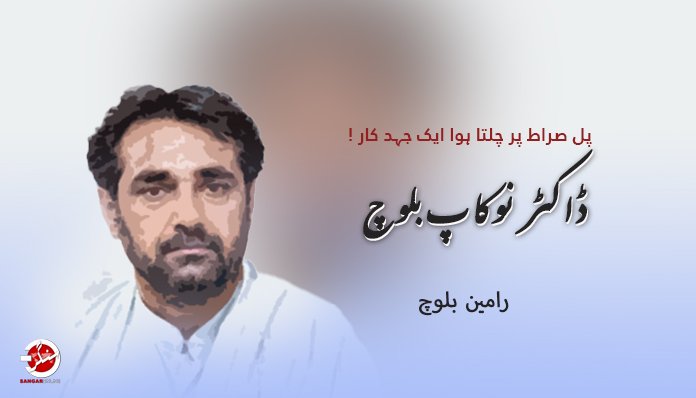
The life and death of Dr Nokap Baloch is also a story of this kind, which cannot be seen narrowly as one individual’s biography, a political activist’s journey or the killing of a doctor. Its meaning is far wider, deeper and more layered. In studying Baloch history, a large part of it is written in nameless homes where evening turns into night while waiting for someone’s return; on roads where the traveller, though far from the homeland, cannot be far from its sorrows; in refugee settlements where life, despite its complete lack of resources, tries to keep itself alive; and in the hearts of people where personal grief takes the form of a national tragedy. This invisible side of history forms a nation’s true collective memory. In this memory, war is no longer just the fighting on the battlefield; it enters every sphere of life. It begins to affect people’s dreams, relationships, livelihoods, education, medical care, love, identity and even their idea of the future.
In this context it would not be wrong to say that when a new phase of the Baloch national freedom struggle began in the early 2000s, its effects were not confined to the political field or the military front. Alongside it a wider human experience was born, in which people had to constantly balance their political ideas, national loyalties, personal lives and questions of survival. Reducing the story of this era to slogans, political positions, war events or ideological debates would amount to ignoring its human dimensions. The real complexity of any historical struggle emerges when we go beyond its grand political narratives and look into individual lives, where ideas are no longer mere words but are paid for with body, mind, family, relationships and the future.
This is the point where the idea of freedom leaves its abstract political definition and becomes a fundamental question of human existence. What, after all, is freedom? Is it only the name of a political destination, or more than that, a human condition in which a person can live in their homeland free from fear, live with their identity, seek the fulfilment of their dreams and have the authority to decide their own future? If the idea of freedom is separated from human life, dignity and authority, it becomes merely an ideological term. But when this same idea settles in the eyes of a homeless person as a memory of the homeland, turns into an impossible wish to return for a refugee, or becomes, in a doctor’s hands, the responsibility to treat a wounded person, its meaning takes on a new depth.
There is no doubt that every freedom activist, whether on the mountain front, the urban front or the front of the pen, has to pass every day and every moment through the fires of heaven and hell and cross the Bridge of Sirat. It is a conscious and logical understanding that the road to freedom is not easy, smooth or free of danger. Anything is possible at any time; dangers are always present; the loss of life cannot be estimated and cannot be avoided. Here the Bridge of Sirat becomes a symbol: the activist standing on it must move forward, yet is also aware that he may fall. Under his feet is a sense of insecurity, while before him lies the vision of a destination whose meaning, despite all its difficulties, compels a person to continue the journey.
In this struggle, freedom is no longer just a destination but a constant trial, in which one must again and again perform a bloody meditation at the shrine of history. Yet the most painful aspect of this Bridge of Sirat is that not all who travel on it pass through the same circumstances. To some falls the battlefield, to some prison, to some separation, to some statelessness, and to some the responsibility of dressing others’ wounds. It is the four-sided beauty of the struggle that people living in the same era and on the same front endure their share of the tragedy in different ways, yet an invisible bond remains between their pain and their thought.
Dr Nokap Baloch’s life takes on a special meaning in this Bridge-of-Sirat context. He takes part in the political process of freedom, joins the platform of the Baloch National Movement, mobilises people and remains constantly active. Throughout, he travels on and moves forward feeling himself in death’s embrace at every moment, because he is consciously aware that the death warrant of those who struggle for freedom has already been signed. The martyrdom of everyone from Shaheed Ghulam Mohammed to Dr Mannan Jan and thousands of party workers is written into its prior inevitability. When circumstances tighten around him, the path of his life changes. He becomes a refugee. Being far from the homeland is not merely distance from land; it is separation from the familiar paths where one spent one’s childhood, loss of the voices in which one’s language and culture echo, distance from the faces in which one’s personal history is preserved, and being cut off from the daily life in which a person naturally feels their identity.
For a person, the homeland is not just geography. It is a reference point of their existence through which they understand their past, give meaning to their present and form their idea of the future. When a person is far from their homeland, a void can open within them that is not easy to fill completely with new land, a new language, a new environment and new relationships. Their life goes on; they find new paths, meet new people and meet the demands of survival, but a corner of their being may remain where the memory of the homeland quietly lives on. This is the torment of exile: a person tries to leave the past behind, but the past keeps travelling within them. An important aspect of Dr Nokap Baloch’s story is also that, forgetting the torment of his exile, he thinks like García Márquez: my compatriots, I have learned so much for you that if I die keeping it all locked in my chest, it will be a wretched death for me.
He becomes a saviour for thousands of Baloch refugees. Going beyond himself, he tries to understand and treat the pain, suffering and illnesses of others. This is where the national, human and intellectual side of Dr Nokap Baloch’s personality emerges, raising him above the role of a mere refugee and bringing him close to his fellow refugees. Had he wished, he could have shut himself in a room within four walls and found a safe path for himself. He knew that countless Baloch refugees there had been martyred in state terrorism, and that he was as unsafe as they were. He also knew the motives behind the martyrdom of Sajid Baloch and Banuk Karima. But instead of seeking his own safety and survival, he took his life in his hands, chose the most difficult stage of life by becoming a saviour to his fellow refugees, and, striving for the lives of others, remained himself exposed to insecurity. This is where the real meaning and greatness of this character emerge: how many hardships he endured in his life, and how much room those hardships created within him for others.
In Baloch history, the importance of figures who turn their personal tragedies into a force that eases life for others has always been extraordinary. Grief can break a person, and it can also broaden their consciousness. Sometimes pain, anguish and torment shut a person inside the walls of the self, while in other circumstances these same torments enable them to understand the suffering of others. When someone has experienced homelessness themselves, they can read more deeply the uncertainty written on the face of a person without a home. When they have faced insecurity themselves, they do not see another person’s helplessness as merely a social problem but feel it as a living human reality.
It is this side of Dr Nokap Baloch’s personality that takes him beyond the identity of a political figure alone. He becomes the symbol of a human experience in which a person affected by political circumstances, rather than abandoning his human responsibilities, takes them up in a new way. He is a refugee himself, yet becomes a support for other refugees; he is living an uncertain life himself, yet tries to create some certainty in the lives of others; he faces a future for which he has no guarantee, yet he puts his knowledge and skills to work for the health and protection of others’ lives.
The medical profession is also a reminder of a basic principle of human ethics: human life, in its fundamental value, is greater than any division of identity. Illness asks no nationality for permission, pain demands no ideology’s endorsement, and a wound does not wait to learn which political position the wounded person holds. The need for treatment brings a person forward in their most basic condition: as a being who feels pain, wants to live and has the right to be relieved of suffering.
In Dr Nokap Baloch’s story, this same moral struggle takes the form of an important question. How could he have known that the person he wanted to treat could become his killer? On one side are his own life, his political and medical experience, his exile and the demands of his own survival; on the other are thousands of people in need of treatment, sympathy and support. In this situation, his example tells us that the meaning of human life lies not only in securing one’s own survival, but sometimes also in dedicating one’s abilities to the survival of others. This is no easy moral choice, because the path of service is itself not free of insecurity. But it is at such points in human history that moral values leave the realm of speeches and become practical reality.
The tragedy of this whole story deepens further when, far from the homeland, a few people come to him disguised as patients and riddle him with bullets. To read this incident merely as the death of one person would be to ignore the moral and human questions hidden within it. Here ends the life of a man who used his knowledge and skill to ease the physical pain of others. Here stops the journey of a man who, despite his own statelessness, chose the path of service for other stateless people. And here emerges a tragedy in which a figure devoted to protecting human life becomes himself the target of violence.
Here we must acknowledge that a person’s last moments cannot take the place of their whole life. If we make his death alone his identity, we will ignore the life that made that death a human tragedy: the circumstances in which he lived, the hardships he faced, the people for whom he used his profession, and how he worked for his nation’s freedom movement. Had he lived, he might have done more and remained more active. He kept meditating at the shrine of history; he must have kept reflecting on the actions, motives and outcomes of the struggle and on his own moral and practical responsibilities. Meditation within the movement here does not mean merely sitting in silence; it is the process of bringing forward one’s abilities, knowledge, thought and teachings, military and fighting skills, hope, boldness, courage and position. To make standing up to colonialism one’s standard is not easy; it is a task that puts life at stake. To stand firm in one’s struggle and position for two decades, neither breaking nor scattering, is the work of a man of iron, not of someone who lives in luxury.
And here a question arises: can death end such a great individual, or can the deeds tied to his character be forgotten after his death? Certainly not. It is colonialism’s key mistake to believe that by killing an immortal person it can end his thought and ideals; this is a sign of colonialism’s own fear and cowardice, which is perhaps pitiable. The story of one person’s killing reaches, in the sound of gunfire, a turning point where the outward continuity of life is cut. But does the end of a person’s life also end the meaning of his character? Certainly not, not at all; this is colonialism’s illusion. The world’s imperialists and mighty empires have filled cemeteries with countless bodies, destroyed nations’ political institutions and damaged their economies, but they could not stop their journey to freedom, because a human being is not only a physical existence but also an intellectual one. A person can be killed, but the future of their ideas and teachings is not decided by the power that kills them.
But the real purpose of remembering a figure should not be only to grieve over his death. If memory becomes only mourning, it may preserve the past but may not create the power to change the future. On the contrary, if memory becomes a means of understanding the values in a person’s life, preserving his thought and inspiring the effort to prevent such tragedies in the future, it can be transformed into a living moral force. Dr Nokap Baloch’s story needs to be read from this shared perspective.
This is the story of a man whose journey, beginning with political commitment, passes through the stages of exile, political struggle, social service and human responsibility, and perhaps that is why this story does not end here. Its continuation lies not in the idea that such incidents cannot happen again; such incidents will likely keep happening until freedom is won. But if, when one falls, another takes his place, carries that force forward with new energy and stays connected to the mechanism for winning freedom to which the martyr was bound, then the longing, grief and anguish of martyrdom can be eased, because the recompense for the martyrs is a free homeland. And is the purpose of standing in meditation at the shrine of history only to shed tears over past tragedies, or to learn from them and strive to build a more just national and human future?
In my view, the meaning of standing in meditation at the shrine of history is that we do not make the pain of the past merely a memorial, but turn it into the consciousness of our present and responsibility for our future. The stories of people walking the Bridge of Sirat of freedom gain their full meaning only when the human experience within them is understood, their thought is taken seriously and the legacy bound to their lives is not forgotten.
***