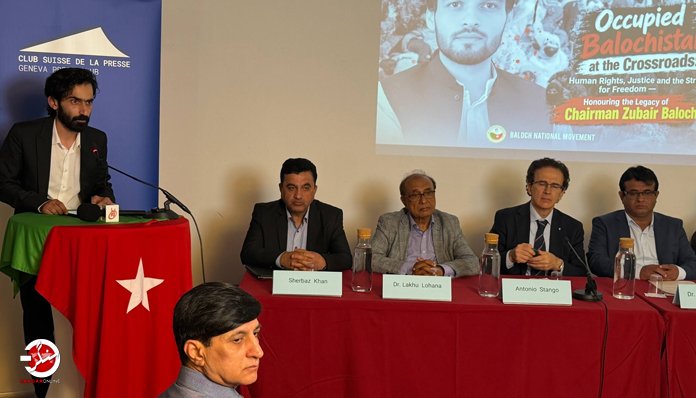
Addressing the 12th Balochistan International Conference organised by the Baloch National Movement (BNM) at the Geneva Press Club, Jamal Baloch, media coordinator of the human rights organisation Paank, presented figures from Paank’s documentation on enforced disappearances, extrajudicial killings and other human rights violations in Balochistan.
The conference was dedicated to the memory of the BNM’s martyred chairman Zubair Baloch.
Jamal Baloch said Paank, the organisation under the BNM’s human rights department, has documented thousands of cases of human rights violations and enforced disappearances over the years. According to him, in the past six months 485 cases of enforced disappearance were reported to Paank and became part of its documented record.
He made clear that this figure includes only the cases reported to Paank through various sources, so it cannot be called the final number of enforced disappearances in Balochistan. According to him, many cases go unreported, especially when the affected families face pressure and threats.
Jamal Baloch said a single case of enforced disappearance is not limited to the victim but affects the whole family. Some families even avoided reporting the disappearance of their loved ones because they were threatened with more family members being disappeared or other consequences.
Paank’s media coordinator said the organisation also received reports of 181 extrajudicial killings in the past six months, several of which Paank has verified.
He said enforced disappearances have continued in Balochistan for decades, and recently cases of women and children being forcibly disappeared have also emerged. In the past six months, 32 cases of enforced disappearance of women and their children were recorded.
Regarding detainees, Jamal Baloch also mentioned incidents of torture and pressure involving children. He said that according to information received by Paank, some detainees have complained of being tortured in front of children and forced to give statements against their will.
Referring to some detainees being presented on Pakistani media, he said that on such occasions some people are forced to read out pre-prepared statements.
Citing Paank’s documented figures, Jamal Baloch said that according to the organisation’s records, on average 81 people are forcibly disappeared in Balochistan every month, and on average 30 of the forcibly disappeared become victims of extrajudicial killing.
He also mentioned drone attacks and aerial bombing in Balochistan, saying six people, including three children, were killed in such attacks last month. A 285-kilogram bomb was used in one attack, in which infants were killed.
Jamal Baloch also mentioned actions against Balochistan’s political activists and the leadership of the Baloch Yakjehti Committee (BYC). He said state power and legal proceedings are being used to suppress peaceful political activists.
He said there have been cases of some political activists first being forcibly disappeared and later shown as arrested. According to Paank’s research, some of the charges brought against these people are baseless.
He added that before action is taken against political activists, attempts are sometimes made through media campaigns to create a negative impression of them, which is part of the wider process of suppressing political voices in Balochistan.
Speaking about the judicial process, Jamal Baloch also cited a recent judicial statement in which a judge mentioned judicial pressure before the media. He said questions also arise about judicial independence and the process of justice in the context of political activists’ cases in Balochistan.
In his address, Jamal Baloch said discussion of the human rights situation in Balochistan is often limited to enforced disappearances and extrajudicial killings, while according to him the problem is far wider.
He said: for us, the priority is simply to say that we have the right to live. Our people have the right to live. We want freedom. We have the right to be free. We have the right to be in our schools.
He said the number and nature of human rights violations are so vast that it is not possible to describe every case in a single address, but it is essential to put forward the people of Balochistan’s right to live, to get an education, to freedom and to basic rights as central human rights demands.