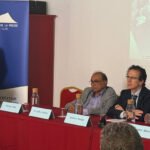
Journalist Shahid Qazi has said Balochistan currently stands at a crossroads where on one side there is continued repression and political conflict, while on the other there is the path of justice, dialogue and the Baloch nation’s right to decide its own political future.
He said this while addressing the 12th Balochistan International Conference organised by the Baloch National Movement (BNM) in Geneva. The conference was dedicated to the struggle and thought of the BNM’s martyred leader Chairman Zubair Baloch.
Shahid Qazi, host of The Unmuted Voice and a journalist formerly with NBC News and ITV, said in his address: for a long time the Balochistan issue has been presented only in a security context, while its human and political dimensions cannot be ignored.
He said: when students protest, they are called a threat. When Baloch families demand information about their missing loved ones, they are viewed with suspicion. When Baloch students raise their voices, they face abduction and violence. When activists demand justice, they are called agents of enemies.
He asked whether “an entire nation” can be declared merely a security problem. Can a mother’s grief or the struggle of a father searching for his missing son be declared a threat to national security?
In his words, these are not security questions; they are human rights questions.
Shahid Qazi said enforced disappearance does not affect only one person’s life but plunges the whole family into continuous uncertainty and torment.
He said: death brings unbearable grief, but enforced disappearance brings uncertainty. A mother waits, a father searches, a sister keeps looking at the door, and a child grows up wondering when his father will come home.
He called it “the disappearance of a whole family’s happiness and peace”.
Shahid Qazi said every family has the right to an answer about its loved one, every detainee is entitled to fair proceedings in accordance with legal requirements, every allegation should be independently investigated and every victim should receive justice.
Referring to Balochistan’s natural resources, Shahid Qazi said the region is rich in minerals, gas and a very important coastline, yet the people of Balochistan face poverty and a lack of basic facilities.
He said: their resources are extracted in the name of development, but no improvement is seen in their lives.
He said even the gas produced in Balochistan does not properly reach many of its towns, and citing his home town of Zhob, he pointed to problems with basic facilities.
He also mentioned poor internet service, saying that in Shal, the capital of Balochistan, internet connections are sometimes shut down for long periods without prior notice in the name of security.
He said: the exploitation of mineral resources cannot be called development. If the dignity of the people of Balochistan is ignored, no port can become a symbol of prosperity.
According to him, lasting peace is not possible without justice, reconciliation is not possible without truth, and trust cannot be built where there is no accountability.
Calling human rights above political, religious or ethnic divisions, Shahid Qazi said: human rights have no political party, no religion, no ethnicity or uniform. Human rights are either for everyone or they have no meaning.
He called on the international community to hear the “credible allegations” emerging from Balochistan, investigate them independently and give observers, journalists, affected families and political voices the chance to play their role without fear.
He said: we are not asking anyone to accept our words blindly. Our demand is only this: listen, investigate and verify. Because truth is not afraid of transparency.
Appealing to the international community to avoid double standards, he said that if the enforced disappearance of a person in Europe matters, it must matter just as much in Balochistan; if freedom of expression matters in Geneva, it must matter in Shal too; and if justice for political prisoners is necessary in some other region of the world, Balochistan’s political prisoners also deserve justice.
He said: do not wait for another tragedy. Do not wait until another generation grows up with only memories of conflict.
Shahid Qazi said the conference’s tribute to martyred Chairman Zubair Baloch is not limited to remembering his name but is a process of keeping alive the principles he stood for. According to him, these principles include human dignity, justice and political rights.
He said: history does not remember political leaders only for the offices they held. They are remembered because they stood up for a struggle greater than themselves.
Shahid Qazi said the people struggling for Balochistan want “not domination but dignity”, and a future in which the people of Balochistan can determine their own political future and political dignity without fear.
Expressing solidarity with the families of the forcibly disappeared, he said they “have not been forgotten”.
At the end of his address he said: “Fear will make you a prisoner, while hope will set you free.”