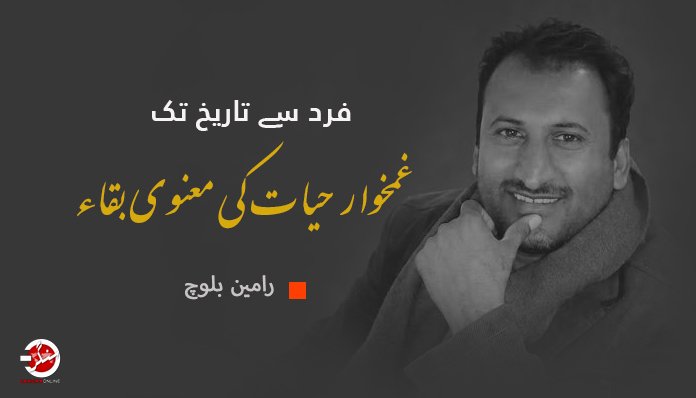
Some people are born onto the calendar of history, some are lost in the dust of time, and some are such that every attempt to erase them only makes their mark on the pages of history deeper. Their lives are not merely the lives of individuals; they are living documents of their society’s anguish and of national and human tragedies. Their days and nights are made up of the harrowing accounts of mutilated bodies, mothers’ tears, sisters’ cries, enforced disappearances, martyrdom in fake encounters, targeted killings, mass killings and the painful scenes of collective punishment. Such people do not merely read history; they live their society’s wounds, bear witness to them and finally become part of history themselves, which even their death cannot bring to an end. They depart physically, but their presence remains in the national memory, in consciousness and in every settled norm of society, raising the question: what, after all, does a person live for?
Hayat was also the name of this step-by-step evolution. His real name was Muhammad Khan, but the name he chose for himself was not merely a literary pen name. He chose for his existence two words that hold a whole philosophical meaning of human life: Ghamkhwar and Hayat. Ghamkhwar, one who feels others’ grief; rather than merely sensing others’ pain or seeing it from the outside, one who tests it against the touchstone of his own anguish. And Hayat, meaning life: that continuous movement which, even in the thick layers of death, must pass through the trial of the true test of its existence. In this name, grief is not a means of escaping life but the awareness to understand life with all its bitterness, contradictions and tragedies. This is truly its meaning: the one who knows how to feel his society’s sorrows also knows the art of living life rather than merely passing it, and only he remains Hayat, alive.
This is not merely a combination of two words but a moral declaration. It is as if, within this name, a person defined his identity and declared: I want to be the representative of a life in which the sorrows of my nation and the people of my occupied society are not foreign to me. I do not want to confine my existence to myself alone, but to bind it to the sorrows of those whose voices are often lost in the aggression of colonialism. And perhaps this is exactly where Muhammad Khan becomes Ghamkhwar Hayat.
A person’s true introduction is not always their birth name. Sometimes they choose a name for themselves that becomes the expression of their inner world, intellectual direction and moral commitment. The name then is no longer merely a means of identification but becomes a pledge of loyalty: a pledge to oneself, a pledge to one’s era and a pledge to the people whose sorrows one feels within one’s own being. This is the depth of meaning hidden in the name Ghamkhwar Hayat. Being a ghamkhwar is not easy. Expressing sorrow at others’ suffering is one thing; making their suffering a matter of one’s own conscience is something else entirely. In the first case a person is a spectator; in the second, they accept the moral responsibility of their era.
Sorrow has always existed in the world, but not every person feels the sorrow of another. Some protect their comforts from others’ suffering, some move on calling it fate, and there are some for whom another’s scream, a mother’s tear and a helpless person’s silence are not merely external events, but break something inside them after which they can never be the same again.
At a literary seminar in Noshki, where Sangat Ghamkhwar Hayat was also present, I raised the question of how far it is right to call a writer, poet or intellectual “universal”. My argument was that if universality means being oblivious to the sorrows, torments and human tragedies of one’s own society, such universality is not literary excellence but a form of intellectual hypocrisy.
Universality does not mean detachment from one’s own land; it means giving the experience of one’s land the breadth of human experience. When a writer is indifferent to the screams scattered around him, stays silent about his society’s slavery and colonisation, yet his conscience awakens at the torments of other nations, it becomes unavoidable to question the moral legitimacy of his sympathy. Shedding tears at others’ pain is certainly a human quality, but averting one’s eyes from the wounds lying at one’s own door makes that same humanism and patriotism suspect.
Literature is not merely the craft of words, the decoration of metaphors and the display of emotions; it is also the creative testimony of one’s era’s consciousness, social contradictions and human anguish. If a writer’s pen is raised for the oppressed of the world but stays silent about his own society’s subjugation, there is a fundamental moral contradiction in his universality. In that case literature, instead of interpreting life, begins to become merely a means of literary fame and moral superiority.
Highlighting this very contradiction, I had said that a writer who is oblivious to his own society’s torments yet emotionally troubled by others’ sorrows is not a writer but a prostitute. It was a harsh sentence, whose purpose was not to demean any profession but to strike at the attitude that subordinates conscience, art and expression to self-interest; that is, the behaviour in which even feeling becomes a display and art becomes a market commodity. The truly universal writer is not one who denies the identity of his soil, but one who gives the sorrow of his homeland the language of human sorrow.
Universality is not achieved by denying one’s social roots; it is born from the depth of those roots. A writer who lacks the moral courage to read the wounds of his era, hear the screams of his society and give words to his people’s anguish should reconsider his claim to universality. For the greatness of literature lies not in a writer mentioning the sorrows of the whole world, but in describing the sorrow he knows with full human truth. If a person keeps looking at his surroundings only with the eye of habit, he may see sorrow yet miss its meaning. But when he looks at life with an awakened national consciousness, society’s pain becomes a question for him: why is there this pain? What is its basis? And does a person bear any moral responsibility in the face of it?
Here, however, a fundamental distinction must also be understood. The philosophy of inner freedom tries to free a person from the slavery within, whereas in national life the question of freedom is also bound up with the colonial conditions that occupy the existence of nations. Mere peace of mind cannot replace the material deprivation of the oppressed, and a mere political slogan cannot cure the indifference within a nation. The full meaning of human freedom perhaps emerges only when consciousness and action, the inner self and society, individual awakening and collective responsibility enter into dialogue with one another.
It is a strange tragedy of human history that sometimes those with the deepest attachment to life are handed over to death. Those who speak of respect for life often find themselves in a world where the sanctity of human life is violated again and again. Ghamkhwar Hayat was martyred, but his martyrdom deepened the contradiction hidden in his name: the man whose name contained life was deprived of life; the one whose identity was bound to others’ grief saw his own grief turn into a question.
Here the question is no longer only about one person’s death. The question becomes: what are the conditions in which human life becomes so unsafe that a person’s existence suddenly turns into an empty space, a condolence notice and a weeping home?
Death is a biological reality. Every living being must one day depart from its physical existence. But the meaning of a human death is not determined only by when the breathing stopped. It is also connected to the life the person lived, the relationships bound to them, the dreams they dreamed, and the questions that remain alive after they are gone.
That is why not every death is the same. Some deaths leave behind only memories, while others write a question on the conscience of their era that time alone is not enough to erase. The moral meaning of the idea of martyrdom also emerges at this point. A martyr’s physical existence may end, but the oppression, conflict and tragedy to which their death draws attention does not necessarily end with them.
The real question is not how many splendid words we can find for death. The real question is what we do to bring life to a point where people do not have to stand again and again at the graves of their loved ones, conversing with their absence. In the landscape of the Baloch homeland, grief does not remain merely a personal emotion. Sometimes it settles in a mother’s eye, sometimes on the empty doorway of a home, sometimes in a father’s broken voice, and sometimes in the silence that descends on a whole family after a relative is taken away. When death, fear, punishment and separation become a constant part of people’s experience in a society, grief leaves its individual bounds and becomes part of national consciousness. Every day bodies fall. Every day mothers weep. Every day a new date of waiting is written in some home. And every day life, in its own homeland, raises questions about its safety and its future. A body is not just a body; it is someone’s child, someone’s hope, someone’s friendship, someone’s future and a basic part of a family’s daily life. When a person is killed, many possibilities that were perhaps about to become reality end with them.
A mother does not lose only her son; she loses a whole chain of her dreams tied to his future. A sister is not deprived only of her brother; she is deprived of the daily presence of a relationship in which even life’s small events had meaning. A widow does not lose only one person; she loses part of her past, their shared experiences and the conversations that may never be completed. If life is defined only as breathing, moving and being physically present, then death is an absolute end. But if consciousness, connection, language, memory and the effects on others’ lives are also counted as part of human existence, the picture becomes more complex. A person can remain present in many senses after they are gone. They remain present in their teachings.
They remain present in the results of their actions. They remain present in the memory of the comrades with whose lives their life was bound. And they can also remain in the questions that become harder than ever to ignore after they are gone.
That is why keeping Ghamkhwar Hayat alive cannot mean only repeating his name. It also means honestly remembering his real life, his intellectual commitments, his national and patriotic ties and his actions. Instead of losing his personality in mythical sanctity, his intellectual and visionary existence should be understood. In the words of a Marxist intellectual, one cannot move forward, pushing exploitative forces out of the way, without making revolution the first step of one’s intellectual journey; for in the context of Baloch nationalism, revolution is not a change of rulers but the process of defeating the military, social, economic and intellectual relations that make one person subject to another.
The spirit of nationalism lies in the awareness that if thought does not challenge the occupying structures of its era, it becomes merely a means of mental comfort. The true intellectual’s role is not to compromise with the oppression of the time but to keep alive the resistance of consciousness against it. He knows that dreaming alone is not enough to move the wheel of history forward; to turn dreams into material reality, confrontation with outdated systems, exploitative tactics and intellectual stagnation is unavoidable.
The sanctity of Ghamkhwar Hayat’s life lies in this intellectual steadfastness: he connected the struggle not merely to a political slogan but to the question of national dignity, social justice and national freedom. His legacy is not to be confined to devotion to a personality, but is a pledge to carry forward the consciousness that recognises exploitation in every era, questions every oppression and makes the freedom of its nation the centre of its intellectual struggle. A person’s true greatness lies not in walking along with history but in struggling to change history in his own favour. This is Ghamkhwar Hayat’s intellectual legacy and the true sanctity of his life.
If every new death in Baloch society gives birth to a new mourning, then this society needs not only memorials but must stay connected to the social, political and resistance paths and highways that make life safe. What does it mean to be alive? Seen from this angle, merely being alive and consciously living life are not the same thing. A person may live for years without ever seriously questioning their existence, their fears, their desires and their social role. In contrast, someone may fight such a historic battle in a short life that they live on despite losing their body. Here the meaning of life is established more by its conscious and moral quality than by its length.
Life is not only about being remembered after death. Life is also the mornings in which a person breathes oxygen in free air, the conversations between friends, the aspirations yet to become reality, and the extraordinary joys we often understand only when they have been taken from us. If Ghamkhwar Hayat is alive in the sense that his name reminds us of the sanctity of life, then that memory demands that we try to create better conditions for the living. To live is not only to stand against death; it is also an effort to change the society so that people can have trust instead of fear, freedom instead of slavery, and a free and dignified life instead of helplessness.
Perhaps that is why it is not enough to regard this name as merely one individual’s identity. It should be remembered along with the question that confronts us after every human tragedy: can we build a society in which one person’s sorrow is not merely news to another?
If we can do this, the meaning of being a ghamkhwar will no longer be merely a pen name but will become a moral value. And if hayat, life, is understood not merely as breathing but as a dignified, safe and meaningful life for the Baloch nation, then the name Ghamkhwar Hayat can give us not only the strength to bow our heads before death but also the courage to stand up for life.
When state repression encircles a society, its division is not merely geographical or political; it divides it into four-sided margins and seeps into human existence itself in the forms of consciousness, fear, interest and resistance. Society splits into different circles: some struggle to turn the possibilities of freedom into reality, some, out of immaturity, fear, privileges and love of a comfortable life, call slavery acceptance, and some remain unable to set their intellectual direction amid this struggle.
Slavery does not always appear in the form of chains; sometimes it wraps itself in the soft sheet of privileges and paralyses a person’s conscience, sometimes it calls fear wisdom and expediency realism. In this way, while protecting his comfort, a person gives up the very meaning of his freedom. But history’s fundamental question is not how many people bowed before fear, but how many remained committed to their human dignity and the idea of freedom despite fear.
The direction of any national or social struggle is determined not merely by numbers, but by the consciousness, steadfastness, courage and sarmachar will that keep freedom alive in the face of oppression. That is why the people taking part in the freedom struggle are of extraordinary importance: they go beyond their own narrow interests and bind themselves to the question of a national future. Their sacrifices put before society the moral question: is giving up freedom for the sake of comfort a success in life, or is protecting human dignity in adverse circumstances?
We are fortunate that our society has activists who are keeping the question of freedom alive by staking their lives, comfort and personal futures. The meaning of their struggle lies not only in their sacrifice but in the historical consciousness they leave behind for their society. For freedom is not merely the name of a destination; it is the process of awakening consciousness, intellectual liberation from fear and making a person the sovereign actor of their own history. The real test of nations is which vision of life they choose between comfortable slavery and difficult freedom. History is finally shaped by the very questions that the conscious people of an era keep alive through their action, thought and sacrifice.
***