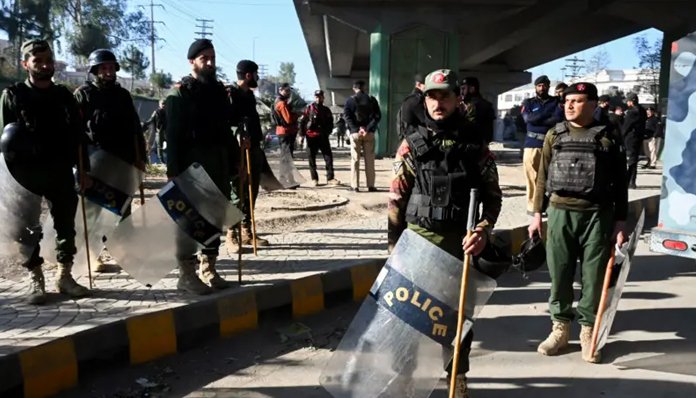
Police in Pakistan’s Khyber Pakhtunkhwa province have decided to use force in the event of violent protests in the province, while Section 144 has been imposed in Rawalpindi and Murree for one month.
Khyber Pakhtunkhwa police have decided to use force in the event of possible unrest and violent protests in the province.
Operational guidelines issued by the office of the Khyber Pakhtunkhwa Inspector General of Police say that in the first stage a warning will be given, while in the second stage tear gas shells will be used to disperse protesters.
According to the guidelines, if this does not work, rubber bullets and pepper-ball guns will then be used.
If protesters do not desist, the IG Police has also issued orders for baton charges, aerial firing and arrests of protesters.
These orders have been issued by IG Police Zulfiqar Hameed to all police officers and personnel in the province under Sections 83 to 88 of the Khyber Pakhtunkhwa Police Act 2017.
The letter directs district police officers to perform duty at protests in person.
It also directs that security be tightened at sensitive installations, including police stations, government offices, petrol pumps, banks, shopping centres and highways.
Meanwhile, Section 144 has been imposed for one month in two cities of Pakistan’s Punjab province, Rawalpindi and Murree.
According to a notification issued by Rawalpindi Deputy Commissioner Captain (retired) Nadeem Nasir, Section 144 will be in force across the district from 10 October to 8 November.
According to the notification, rallies, processions and gatherings of five or more people, as well as carrying weapons, sticks and petrol bombs, will be banned across the district.
In addition, pillion riding on motorcycles and the use of loudspeakers will also be banned.