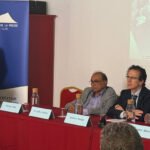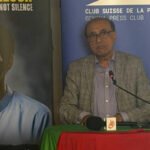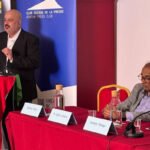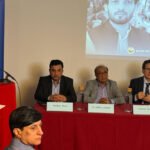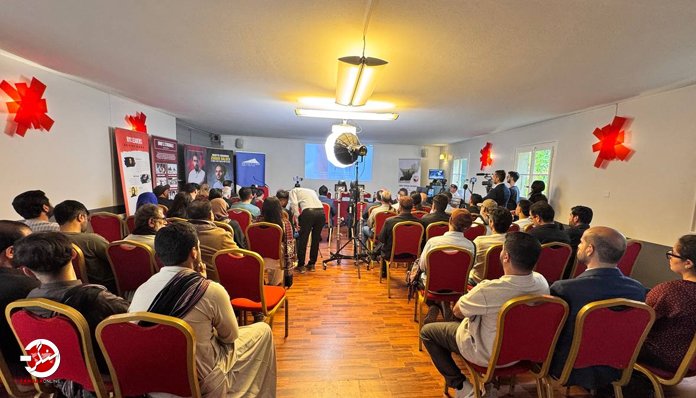
The Baloch National Movement (BNM) held its 12th Balochistan International Conference at the Geneva Press Club during the 63rd session of the UN Human Rights Council, discussing the human rights situation in Balochistan, enforced disappearances, arrests of political activists, natural resources, the right to self-determination and the region’s political future.
The conference was titled “Occupied Balochistan at a Crossroads: Human Rights, Justice and the Freedom Struggle, a Tribute to the Legacy of Chairman Zubair Baloch”.
Besides Baloch political activists and human rights representatives, the conference was attended by Sindhi, Pashtun, Afghan, Kashmiri and Gilgit-Baltistan representatives. Human rights experts from Europe, a British MP and journalists also spoke. The conference was part of the BNM’s three-day Geneva campaign, during which the organisation highlighted the situation in Balochistan before international bodies and international representatives.
Speakers at the conference included Baloch National Movement chairman Dr Naseem Baloch; Pashtun Tahaffuz Movement (PTM) leader Manzoor Pashteen; British Labour Party MP and former Shadow Chancellor John McDonnell; Sindhi nationalist leader and leading World Sindhi Congress figure Dr Lakhu Luhana; Jamal Baloch, media coordinator of Paank, the BNM’s human rights body; Jeay Sindh Freedom Movement chairman Sohail Ahmed Abro; Workers Party Gilgit-Baltistan representative Sherbaz Khan; Afghan author, writer and former Afghan ambassador to Iran Dr Ghafoor Liwal; Antonio Stango, president of the Italian Federation for Human Rights (FIDU) and professor of international organisations and human rights at Link Campus University in Rome; and Balochistan journalist Shahid Qazi. The conference was hosted by BNM members Mehra Baloch and Saleem Baloch.
Dr Naseem Baloch: Behind Every Report and Statistic From Balochistan Is a Human Being
In the conference’s keynote address, BNM chairman Dr Naseem Baloch said this gathering is not just another political gathering but the voice of the human lives that reflect the situation in Balochistan.
He said behind every report, every photo and every statistic from Balochistan there is a human being.
According to him, a mother is waiting for the return of her forcibly disappeared son, a child is growing up without a father, and families are asking at prison gates where their loved one is.
Dr Naseem Baloch also remembered BNM central committee member Dr Abdul Rasheed, alias Dr Nokap Baloch, who was killed by Pakistani army agents on 10 September. He said the armed men came posing as patients and killed the man whose work was to treat people.
Referring to the political struggle and thought of Shaheed Chairman Zubair Baloch, he said he was targeted for speaking of national freedom, rejection of occupation and creating political awareness among the youth.
In his words, the enemy took Zubair Baloch from us but could not take away his political vision.
Dr Naseem Baloch also mentioned the life sentences of Dr Mahrang Baloch, Sibghatullah Shah Ji and Gulzadi Baloch. He said the BNM’s political position is a free and sovereign Balochistan, and the struggle for human rights cannot be separated from the struggle for national freedom.
His address presented Balochistan’s humanitarian crisis not merely as statistics but through the families and individuals directly affected by these conditions.
Manzoor Pashteen: Those Who Raise Peaceful Voices Are Being Jailed and Given Life Sentences
Pashtun Tahaffuz Movement (PTM) leader Manzoor Pashteen addressed the conference by video link.
Referring to Mahrang Baloch, Bebo Baloch, Gulzadi Baloch, Bebarg Baloch, Sibghatullah Baloch and other activists, he said their only crime is raising a peaceful voice.
In his words, the state jailed them and gave them life sentences.
Manzoor Pashteen said Baloch young men are being forcibly disappeared daily, while women and children at home are being targeted in air strikes. According to him, those who raise questions about natural resources are declared terrorists and sent to jail or forcibly disappeared.
Referring to Pashtun areas, he mentioned more than two hundred thousand affected people and thousands of deaths and missing persons. According to him, 72 children aged one year or younger were killed in military drone strikes in Khyber Pakhtunkhwa during 2025 and 2026.
Addressing Europe, he said that if a major political step is not possible, at least no more funds and weapons should be provided to such a state.
Calling the Pakistani prime minister a flatterer of Trump, he said one man’s flattery is being given more importance than hundreds of thousands of deaths.
John McDonnell: Britain Should Recognise the Baloch People’s Right to Self-Determination
British Labour Party MP and former Shadow Chancellor John McDonnell addressed the conference by video link. He has represented Hayes and Harlington since 1997.
He said Britain’s colonial history places a special responsibility on it to recognise the Baloch people’s demands for peace, justice and the right to self-determination.
John McDonnell said he will continue to provide political and diplomatic support in Britain to Baloch affected by Pakistani repression.
Referring to new restrictions, he said they have increased the difficulties of asylum seekers. In his words, some people seek asylum because their lives are in danger.
He also acknowledged that changing British policy is not easy because of relations between London and Islamabad. However, he said long discussions are needed with the new leadership on urgent issues and civil liberties.
Dr Lakhu Luhana: Balochistan Is Not at a Crossroads but on the Road to Freedom
Sindhi nationalist leader Dr Lakhu Luhana, formerly associated with the World Sindhi Congress, disagreed with part of the conference title, saying Balochistan is not at any crossroads but on the road to freedom.
He said the night of slavery fell on Balochistan on 27 March 1948. “That night has not ended; it is getting deeper.”
Referring to Balochistan’s natural resources, Dr Lakhu Luhana said that despite the presence of gold, copper, coal, gas and oil, poverty and malnutrition persist in the region, while maternal and child mortality rates are also high.
Citing Sui gas, he said most of the gas has been extracted, yet women still travel miles to get water.
He asked how many more bodies from Balochistan must bleed before the world accepts that atrocities are taking place and need to be stopped.
Inviting Sindh and Balochistan to move together on a shared political journey, he said Balochistan is not at a crossroads but on the road to freedom.
Paank: 485 Enforced Disappearances and 181 Killings Reported in Six Months
At the conference, Jamal Baloch, media coordinator of the Balochistan human rights body Paank, presented figures from the organisation’s documentation report.
According to Jamal Baloch, over the past six months Paank received reports of 485 enforced disappearances and 181 extrajudicial killings. According to him, 32 disappearances of women and children were also recorded.
He made clear that these are only the incidents that reached Paank, while many families do not report incidents because of threats.
According to him, on the basis of the six months’ figures, an average of 81 enforced disappearances were reported each month, while an average of 30 of the disappeared were killed. External reporting on 25 September also highlighted the monthly average and reported figures presented by Paank.
Jamal Baloch also mentioned drone attacks and aerial bombing in Balochistan. According to him, six people, including three children, were killed in such attacks last month. He said a 285-kilogram bomb was used in one attack.
Regarding political activists, he said they are first forcibly disappeared, then shown as arrested and made to read prepared statements on the media.
He said: we have the right to live. We want to be free. We have the right to be in our schools.
Sohail Ahmed Abro: Referendums Should Be Held in Balochistan, Sindh and Other Regions
Jeay Sindh Freedom Movement chairman Sohail Ahmed Abro said Balochistan was an independent state for centuries and came under military occupation on 27 March 1948.
He said the state sees not people, but mines and land.
Sohail Ahmed Abro said more than 30,000 Baloch are forcibly disappeared, while more than eight thousand people have been killed over the years. He also mentioned the aerial bombing in Surab.
Calling the Sindhi, Baloch, Pashtun, Kashmiri, Gilgiti-Balti and Saraiki peoples oppressed nations under the same occupation, he proposed adopting a joint strategy.
He demanded that the United Nations hold referendums in Balochistan, Sindh, Pakhtunkhwa, Jammu and Kashmir, Gilgit-Baltistan and the Saraiki Waseb.
At the end of his address he repeated G. M. Syed’s words: freedom is our right, freedom is possible, and one day we will win freedom.
Sherbaz Khan: Solidarity From Gilgit-Baltistan
Workers Party Gilgit-Baltistan representative Sherbaz Khan addressed the conference and expressed solidarity with the other oppressed nations of the region.
He expressed solidarity on behalf of the people of Gilgit-Baltistan with the nations in the region struggling for rights and political demands.
Dr Ghafoor Liwal: The World Is Not Yet Hearing These Issues Properly
Afghan author, writer and former Afghan ambassador to Iran Dr Ghafoor Liwal addressed the conference by video link.
He said human rights violations in Balochistan and Pashtun areas have not yet been properly understood internationally.
In his words, families have lost loved ones. Women and children are taken from their homes. Tortured bodies are found later. Thousands are forcibly disappeared.
He said the problem is not only human rights violations but also that the world is not fully aware of these people’s demands and the reasons for their sacrifices.
Dr Ghafoor Liwal identified two fronts in this regard. According to him, one front is making people at home aware of their rights, while the other is getting credible information to the international community.
He said people living under pressure cannot do this work themselves, so exiled intellectuals, journalists and communities must become their voice.
He said this is not just a struggle for facts. It is a struggle for an audience, a struggle for truth, a struggle for education, and a struggle for someone’s voice to be heard.
Antonio Stango: Many Nations Have Limited Access to International Institutions
Antonio Stango, president of the Italian Federation for Human Rights (FIDU) and professor of international organisations and human rights at Link Campus University in Rome, spoke about the global human rights system and how it works in practice.
He said the theory of human rights and the reality of human rights violations are drifting further apart.
According to him, when representatives of nations deprived of collective rights attend UN sessions, some government representatives call them terrorists and say they should be in prison, not at the forum.
He said this conference is being held at the Geneva Press Club rather than the Palais des Nations because some governments oppose such meetings inside the United Nations.
Antonio Stango agreed with the conference’s position that lasting peace is not possible without justice and there can be no reconciliation without trust.
Describing the International Criminal Court in The Hague as a court for serious international crimes rather than a political court, he said international justice must work.
Shahid Qazi: The Balochistan Issue Cannot Be Seen Only Through a Security Lens
Balochistan journalist Shahid Qazi, host of the programme “The Unmuted Voice” and formerly with NBC News and ITV, spoke about the political and human dimensions of the Balochistan issue.
He said the Balochistan issue has long been presented only through a security lens, while its human and political dimensions cannot be ignored.
He said student protests, the search for a missing son and the demand for justice are not a threat to national security but a question of human rights.
In his words, death brings grief. Enforced disappearance brings uncertainty.
He said Balochistan’s natural resources are extracted, yet people’s lives do not change. If people’s dignity is ignored, no port can become a symbol of prosperity.
He told the international community not to accept any claim blindly, but to listen, investigate and verify.
In his words, truth is not afraid of transparency.
He said that if a person’s disappearance in Europe is an important issue, a disappearance in Balochistan must also be considered important, and if there is a right to freedom of expression in Geneva, that right must also exist in Shal.
He ended his address with the sentence: fear will make you a prisoner; hope will set you free.
Conference Ends With Emphasis on Seeing Human Rights, Justice and Political Future Together
The various addresses at the conference presented the situation in Balochistan as interlinked questions of human rights, enforced disappearances, arrests of political activists, natural resources, justice, the right to self-determination and the political future.
In their addresses, speakers also mentioned the issues of Sindh, Pashtun areas, Kashmir, Gilgit-Baltistan and the Saraiki region alongside Balochistan, and identified the shared political and human rights aspects among them.
At the end of the conference, the speakers’ common point was that the questions of imprisonment, enforced disappearance, natural resources and the political future in Balochistan cannot be seen separately from one another.
The conference was dedicated to the political struggle and thought of Shaheed BNM chairman Zubair Baloch, and through it the human rights and political issue of Balochistan was presented to international human rights circles, political representatives, journalists and other participants in Geneva.