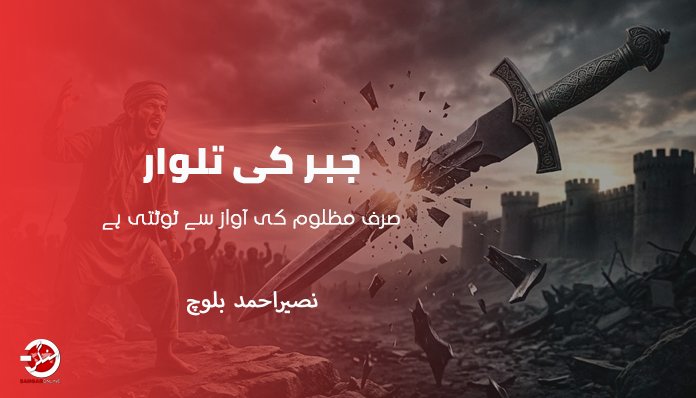
The desire for freedom lives in the depths of human existence. No individual likes to be deprived of their will, dignity and agency, and no nation willingly accepts that decisions about its identity, language, land and future should be in others’ hands. Even in the heart of a person confined within the walls of slavery, the dream of a free morning stays alive: a morning in which they have the right to speak their mind, live with their identity and choose the path of their future.
But between the desire for freedom and its attainment lies a hard journey. People wish that the chains of slavery would break without any pain, but systems of oppression do not give way merely because someone wishes it. Changing them takes awareness, perseverance, mutual trust and organised struggle. On this journey there are difficulties, despair sets in, and at times the destination seems to move further away. It is in such moments that a movement’s resolve is tested: how far it stays loyal to its goal, its principles and its people.
The oppressor does not only try to keep the oppressed down by force; he also wants to make them believe that the present situation can never change. He makes fear part of daily life, calls questioning a threat and presents silence as the path to safety. When people begin to fear the consequences before speaking up for their rights, oppression gains a convenience for its domination that it does not need to keep up by using force all the time.
In understanding this silence, it is also necessary to understand the helplessness of the oppressed. Not every silent person supports oppression. Some worry about their children, some fear losing their livelihood, and some have already endured so many shocks that they cannot gather the courage to speak further. Awakening therefore requires that, instead of leaving a frightened person alone, we become their support, listen to their pain and build a collective trust in which they feel their voice is safe and meaningful.
The voice of the oppressed draws strength from this very trust. This voice does not rise only as a slogan; sometimes it comes from the pen, sometimes it is preserved in a book, sometimes it is heard in a mother’s question, and sometimes it takes collective form in a peaceful struggle for justice. Bearing witness to the truth, keeping a record of injustice, presenting the facts honestly and insisting on human dignity despite fear—these are all forms of that voice.
However, the effect of a voice is also tied to its truthfulness and direction. The case of the oppressed is stronger when it is based on research, clear demands and principles it wants upheld both for itself and for others. A freedom struggle must develop within itself the capacity to tolerate disagreement, admit mistakes and protect the dignity of the weak. It is these attitudes that lay the foundation of the free future being dreamed of.
One voice raised does not immediately end the whole system of oppression, but it does challenge the idea that the system is invincible. When one person tells the truth, another finds a witness to their own experience; when many voices join together, individual pain becomes a collective question. That question then finds a place in homes, books, social institutions and public life. In this way, the grip of fear can gradually weaken and possibilities for change emerge. That is why perseverance is of fundamental importance on the journey to freedom. The result of every effort is not immediately visible. Sometimes one generation raises the question, the next gives it an intellectual foundation and a third sees its fruits. The durability of a struggle lies in keeping its connection to truth, knowledge and human dignity despite difficulties, and in leaving understanding along with hope for the generations to come.
The sword of oppression is broken only by the voice of the oppressed. In this sentence, voice means the awakened consciousness that recognises oppression, the pen that preserves the truth, and the collective resolve that does not let people give up their dignity and agency. When this voice rises with truth, unity and continuous action, it confronts oppression with a question that can no longer be silenced for ever by force.
The tactics of oppression and the intellectual awakening of the oppressed: along with its struggle, an oppressed nation also needs to understand the methods by which oppression maintains its domination. The use of force is its visible side; alongside it, a whole system of interests, fear, political patronage and propaganda can also be at work. This system tries to divert the oppressed from the question of their rights and entangle them in mutual distrust and internal conflict. In this way their collective strength weakens and it becomes easier for the oppressor to keep his power.
One complex form of oppression is that, to suppress a nation, it enlists the services of some individuals and influential circles from that same nation. People who know the local language, family ties, social traditions and conditions of the area can be more useful to it. Some are won over with wealth and privileges, some are given hope of office and power, and some are used through threats or coercion. In this way, the interests of power are advanced through local faces, and responsibility for oppression also becomes blurred.
Where armed patronised groups or so-called death squads are active, fear is not limited to one person. Its effect can fall on the whole of society. People begin to feel unsafe about their relationships, conversations and daily activities. Fear of informers can make friend suspicious of friend and neighbour suspicious of neighbour. In such a situation, one aim of oppression is also that people withdraw from collective life and lose trust in one another.
But in such conditions, the need for caution and fairness grows even greater. Labelling someone an informer or an associate of an armed group merely on the basis of disagreement, rumour, personal grudge or political affiliation can cause serious injustice. Accusations of this kind require credible evidence and responsible investigation. The moral strength of the struggle of the oppressed lies in protecting the lives, dignity and rights of its people and not giving room to baseless accusations in an atmosphere of fear.
In the political arena too, the methods of oppression are not always direct. Attempts can be made to influence the priorities of a party or influential political circle by offering hope of a share in power, offices, financial benefits or state patronage. The danger in this relationship arises when those who claim to represent the people begin to give priority to protecting their own position and privileges instead of raising their people’s basic questions. Representation can then become a means of winning public acceptance for the decisions of power, instead of carrying the people’s voice to power.
To judge the role of a political party or leader, it is necessary to look beyond its slogans. Its decisions, financial interests, accountability to the public and conduct in difficult times give clearer evidence. Does it question injustice? Does it speak up even when the rights of its own supporters are violated? Can the public disagree with it and hold it to account? With these questions, a political role can be assessed more seriously. Merely choosing a different political path is not proof of anyone’s dishonesty; but no path should be above criticism either.
In today’s world, the media and social media are of extraordinary importance in this struggle. Information can spread very quickly through them, but misleading narratives can also be spread at the same speed. Showing only one side of an incident, giving no space to the voices of those affected, mixing peaceful demands with violence, or making the actions of a few people the identity of a whole nation—all of these can become ways of influencing public opinion. Propaganda is sometimes built not on outright lies but on half-truths, selective silence and accusations repeated again and again.
When the identity of an oppressed person is made suspect even before their plea is heard, the question of justice fades into the background. The conversation moves away from what happened to them and gets caught up in the debate about why they should be given the right to speak. This is where the responsibility of the aware reader, journalist and political activist grows: to keep the distinction between accusation and evidence, news and commentary, and the actions of an individual and the rights of a whole population. For an oppressed nation, the effective answer to this propaganda is to make its information credible. Accurate dates of events, verifiable evidence, testimonies preserved with the consent of victims, and clear demands strengthen its voice. Correcting false news that comes from its own ranks is also part of this honesty. Admitting a mistake does not weaken the case; insisting on it damages trust.
Therefore, in the struggle for freedom, along with understanding the tactics of oppression, it is also necessary to build trust, political insight and critical awareness within. Disagreement with the oppressor is one thing, but listening to one’s own people, respecting their disagreement and remaining accountable to them is the foundation of future freedom. The voice of the oppressed becomes a more lasting force when it carries the courage to stand against oppression, the honesty to state the truth, and the wisdom to keep its people united.
***