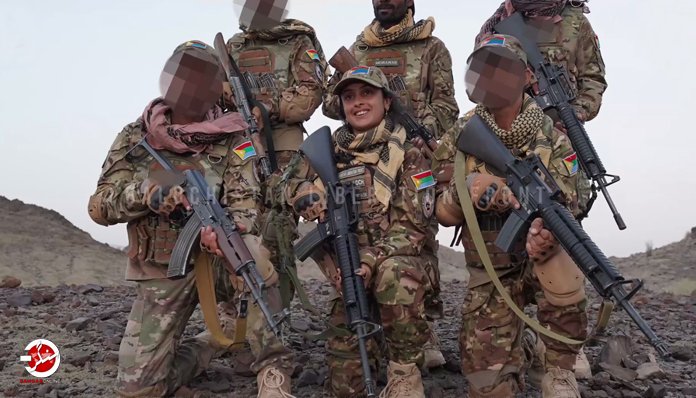
Major Gwahram Baloch, spokesperson for the Baloch pro-independence armed organisation Balochistan Liberation Front (BLF), has released the details of ‘Operation Almas’ in Gwadar to the media.
According to the spokesperson, more than 80 military and intelligence personnel were killed in comprehensive, coordinated, organised and effective attacks by the BLF’s special military units on centres of the Pakistani army, the colonial intelligence network and exploitative institutions in Gwadar. During the actions, several armoured vehicles, the main military barracks and spy offices were destroyed, 4 quadcopters and 2 surveillance drones were destroyed in the air, a police station was captured, and deadly attacks were also carried out in Gabd and Rimdan 250.
According to the spokesperson, ‘Operation Almas’ has ended successfully after dealing a heavy blow to the state’s exploitative designs.
The spokesperson said the Balochistan Liberation Front formally presents to the nation, to the subjugated nations and to the international community an account of all the far-reaching military and political successes of Operation Almas, the historic, organised, effective, coordinated and comprehensive military battle launched at 4 pm on 22 October 2026 against the occupying Pakistani state structure in Gwadar and the adjoining coastal region. This operation is the most organised, coordinated and far-reaching action to date against the occupying Pakistani state, its usurping army, its intelligence network, its exploitative economic institutions and the local puppet administration. This battle expresses the organisation’s resolve and capability, and shows that the revolutionary participation, shoulder to shoulder, of fearless Baloch women and men sarmachars in the struggle for the Baloch nation’s freedom, national survival and the defence of its coast and resources heralds the end of usurping colonialism.
He said this great historic operation has been named after the BLF’s fearless and brave guerrilla commander Almas Baloch. For the past 8 years, Commander Almas had been active, engaged and ideologically committed to the armed national defensive struggle on the platform of the Balochistan Liberation Front. In Dasht, Turbat and Gwadar, she worked with the intelligence wing as an active member, passing important information to the organisation. During military offensives, she carried out the important duty of delivering logistical support to sarmachars in the mountains on the Dasht front in the harshest conditions. Commander Almas was tortured by Pakistani army and state death squad personnel and was seriously injured, yet she stood firm on the armed front and kept the flag of the freedom struggle high. State institutions repeatedly tried to abduct Almas, but she was not prepared to step back even one step from her goal, and she went underground in various areas of Balochistan and carried out her organisational duties well. By facing state repression with fortitude, Almas nurtured the idea that every kind of hardship is acceptable on the path to national freedom, but national slavery is not acceptable under any circumstances. To nurture this idea in practice, Almas decided to sacrifice herself. Commander Almas carried out her duties in various units of the Balochistan Liberation Front and became part of the Saddo Operational Battalion as soon as it was founded. She was second-in-command of this historic Operation Almas, and she not only played a key role in the military and strategic planning of this complex and coordinated battle, but also led from the front line of sarmachars on the battlefield, inflicting heavy losses of life and property on the occupying Pakistani army. To pay tribute to Commander Almas for her brave and active role on various fronts of the national war of freedom, the leadership of the Balochistan Liberation Front has named this historic operation after her. All future operations carried out in defence of our coast will also be named Operation Almas, so that the Baloch nation and the nations of the world always remember Almas’s sacrifice.
He said the courage, wise strategy and front-line leadership that Commander Almas showed on the battlefield buried all the outdated ideas of those who believed Baloch women would play only the role of spectators in this national war. By fighting shoulder to shoulder in this battle, the Baloch woman has proved that in this war of freedom, this form of mother, sister and daughter will be a constant torment for the occupying state, from which it has no way to escape. Commander Almas’s outstanding leadership, bravery and continuous struggle, from women’s participation on the military front of the Baloch national freedom movement to commanding on the battlefield, will be a guiding light for Baloch women. This revolutionary participation of the Baloch woman is a deep historic blow to the occupying state and its patriarchal and usurping mindset, which was under the illusion that women’s role in Baloch society was weak; and Almas’s immortal role in the national struggle will act as a wall against the state’s colonial intellectual onslaught on Baloch society.
The statement said that at 4 pm on 22 October 2026, Jind Nadar sarmachar Mujahid Mehr, alias Sigar Zamrani, of the Balochistan Liberation Front’s special and highly trained military unit, the Saddo Operational Battalion (SOB), formally began this history-making and unprecedented action with a deadly and effective attack on the main fortress of the occupying Pakistani army. Mujahid Mehr rammed his explosives-laden vehicle into the main gate of the central camp in Gwadar of the occupying Pakistani army and its important exploitative military organisation, the Frontier Works Organization (FWO), setting off a powerful explosion. The main aim of this Jind Nadar attack was to completely shatter the enemy’s strong military and defensive ring, paralyse its nervous system, and fully clear the way for fellow sarmachars to advance inside the camp. It was an organised, coordinated and comprehensive attack, under which, at exactly the same time, simultaneous actions were also launched on the occupying army’s camps and posts in Gabd and 250 Rimdan. All the other military units of the Balochistan Liberation Front, including the Qurban Unit, the Karima Armed Assault Division, the Sniper Tactical Team and the Intelligence Unit, simultaneously began carrying out their planned military strategy on a large scale in Gwadar, Gabd and Rimdan 250, paralysing the occupying Pakistani army’s regional defence network within moments.
Major Gwahram said that as a result of the great sacrifice and powerful explosion of Jind Nadar sarmachar Mujahid Mehr, alias Sigar Zamrani, the camp’s main gate, the adjoining police post and all the security rooms at the entrance were completely destroyed, and all the military personnel posted there were killed on the spot. As soon as the main defensive route was cleared, all the other sarmachars of the Saddo Operational Battalion (SOB) entered the camp. On entering the camp’s perimeter, SOB sarmachars began to advance with high military discipline. The sarmachars’ first military and strategic target was the main office inside the camp of the occupying Pakistani army’s notorious spy agency, Inter-Services Intelligence (ISI). The sarmachars attacked this secret ISI headquarters from two sides with rockets, grenades and automatic weapons. In this attack, an ISI officer was killed along with 5 other personnel and armed guards.
He said that after destroying this most important spy centre, the sarmachars headed for another military administrative office inside the camp. After very close, face-to-face fighting, 6 personnel there, including a Military Intelligence (MI) captain, were killed and that office was also destroyed. The sarmachars then targeted the occupying Pakistani army’s main multi-storey residential barracks, where the enemy had taken shelter. A long clash began inside the barracks between the sarmachars and the occupying Pakistani army. During room clearance and fierce fighting on the various floors of the barracks, 12 personnel on the first floor and 9 personnel hiding on the second floor were killed. A total of 21 personnel were killed in the battle in the barracks.
According to the spokesperson, after taking full control of the barracks building, the sarmachars made the tall building their captured position, and from there completely paralysed any movement by the occupying Pakistani army in the whole building and inside the camp. After the building was captured, the occupying Pakistani army launched several attacks one after another throughout the night to advance on the camp and retake it, but every attack failed completely in the face of the sarmachars’ resistance and firm resolve. During the heavy clashes and siege, the occupying army used its spying equipment for surveillance, but the sarmachars acted in time and successfully shot down 4 of the enemy’s attacking quadcopters and 2 advanced surveillance drones in the air during the attack.
He said that in the darkness of the night, 9 separate and fierce military clashes took place between the sarmachars and the occupying Pakistani army. In the first clash, the sarmachars killed more than eleven personnel of the occupying Pakistani army; in the second, more than 7 more army personnel were killed; and in the third, more than 3 soldiers were killed. In the following six continuous clashes, dozens of personnel of the occupying Pakistani army were seriously injured and killed, after which the occupying Pakistani army’s personnel were forced to retreat. Having completely lost the ability to fight face to face inside the FWO’s main camp, the occupying Pakistani army began firing mortar shells from a distance from the last part of the night until dawn, which kept falling on the buildings inside the camp. As soon as the sun rose, the sarmachars’ positions in the camp were continuously targeted with artillery shells, and Almas and Nodan were slightly injured, but despite their wounds their spirit did not diminish in the slightest and they continued to fight the occupying Pakistani army with full resolve.
The statement said that in the morning, the occupying Pakistani army made a last and fiercest attempt to storm the camp with fresh troops and armoured vehicles, but in the face of the sarmachars’ excellent defensive strategy, they once again had to retreat in complete failure, disgrace and defeat. In this battle, about 13 personnel of the occupying Pakistani army were killed and 2 of their armoured vehicles were completely destroyed.
He added that after holding complete and historic control of the camp for more than 20 hours, when all the sarmachars had run out of ammunition and were down to their last bullets, they made final contact with their operational command and gave their historic message: that, with the revolutionary philosophy of the last bullet, they were taking the historic step of sacrificing themselves for the victory of a free Balochistan and for national dignity. Operation Almas was begun by our Jind Nadar sarmachar Sigar Zamrani with the explosion of an explosives-laden vehicle, and Operation Almas was ended by fellow sarmachars, including Commander Khalid, following the philosophy of the last bullet.
According to the organisation, under the formal and coordinated plan of Operation Almas, the BLF’s Qurban Unit and other units carried out simultaneous coordinated actions in Gabd and Rimdan 250 as well as in Gwadar. Along with the attack on the FWO’s main camp in Gwadar, coordinated attacks were carried out on the occupying army’s positions in Gabd and Rimdan 250, where the enemy suffered heavy losses of life and property and its defending units were badly pushed back.
He said Qurban Unit sarmachars attacked the Mazhani police station in Gwadar. During the action, a security official from Punjab was killed while the rest managed to flee. At the same place, Mazhani, the sarmachars set fire to 3 bowsers linked to the plunder of the national coast and resources and to Punjab’s economic interests.
The statement said the sarmachars also set fire to and destroyed 2 large vehicles used to serve the economic interests of the exploitative state and its army at Gabd Kalato, and partly damaged several other vehicles. Qurban Unit sarmachars attacked and captured the Gabd Kalato police station. The sarmachars also seized a government vehicle from the police station. After the action, when a unit of the occupying Pakistani army arrived to advance, a fierce 2-hour clash took place with them at the Gabd Kalato bridge. During this clash, 1 vehicle of the occupying Pakistani army was completely destroyed; the 8 personnel in it were killed and several injured.
Major Gwahram Baloch said that as Operation Almas began, another unit of sarmachars surrounded the Gabd police station from all sides. Following human, moral and national principles, the sarmachars urged the local personnel in the police station to lay down their arms so that there would be no loss of life, but they made a failed attempt to resist as instruments of the occupying state, so the sarmachars attacked the police station with rockets, grenade launchers and other heavy weapons, setting it on fire and damaging the government building. At exactly the same time, another unit of sarmachars targeted the occupying Pakistani army’s camp at the 250 border point with rockets and heavy weapons, killing and injuring several personnel of the occupying Pakistani army. During the attack, several personnel fled across the Iranian border and took shelter in Iranian army positions. After the attack on the camp, the sarmachars stopped and searched trailers, trucks and other vehicles involved in the plunder of national resources and in colonial trade, and set fire to vehicles linked to the occupying state’s economic interests.
He added that as the sarmachars were withdrawing after completing the action, they ambushed a convoy of 3 vehicles carrying personnel coming to help the occupying Pakistani army. In the 2-hour clash, dozens of personnel of the occupying Pakistani army were killed and injured, and all their vehicles were disabled.
He said that in the combined actions of all BLF units during Operation Almas, more than 80 military and intelligence personnel of the occupying Pakistani army were killed, including a Military Intelligence (MI) captain, an ISI officer and SSG commandos, and dozens were seriously injured. During the operation, the sniper team killed 6 personnel. 12 armoured vehicles, supply trucks and reinforcement convoys of the occupying Pakistani army were completely destroyed and disabled. During the battle, 4 attacking enemy quadcopters and 2 surveillance drones were targeted and shot down in the air. 5 large bowsers and several commercial trailers and trucks were burned. The police stations in Mazhani and Gabd Kalato were captured, and the FWO and ISI main headquarters, offices, barracks and several security posts were destroyed with explosions.
According to the organisation, at every turn of history, whenever a subjugated and oppressed nation has decided to break the chains of colonial domination, constant repression and subjugation, it has written the chapters of its future with its blood. The region of Balochistan, which because of its geographical importance, mineral wealth and long coastline has always been coveted by foreign usurpers and imperialist powers, has long been ground down in the mill of state repression, economic exploitation and military aggression. For more than seven decades, this so-called state called Pakistan has occupied the land of the Baloch nation against its will, recklessly looted its resources and made despicable attempts to drive its dignified inhabitants out of their homeland. The Baloch nation has never accepted this colonial repression and slavery as its fate; in every era it has kept the flag of strong resistance flying on the intellectual, political and armed fronts. In this continuous and unconquerable journey of resistance, the Balochistan Liberation Front has emerged as a wall of steel that has repeatedly humbled the occupying state’s arrogance and military pride. The historic battle of Operation Almas in and around Gwadar is a glorious and shining link in this chain, which will play a key role in changing the military balance of the region.
The statement said that the success of any national freedom movement depends on its ideological maturity, organisational discipline and the firm resolve of its sarmachars. The military understanding and political insight with which the Balochistan Liberation Front planned Operation Almas show in practice that Baloch sarmachars are no longer limited to a defensive war; they are fully capable of entering the enemy’s home and smashing the fortresses it considers impregnable.
He said Operation Almas is a coordinated, comprehensive and phased strategic plan that simultaneously paralysed the occupying army’s intelligence networks and its exploitative arms. The greatest distinction of this battle is that the sarmachars not only captured the enemy’s main camp but kept control of it for more than 20 hours. Shooting down four of the enemy’s advanced quadcopters and two surveillance drones in the air is a practical demonstration of the sarmachars’ technical capability and the beginning of progress in this important field of warfare. The message given by the Jind Nadar sarmachars under the revolutionary philosophy of the last bullet has been carved for ever on the milestones of history. This sacrifice shows that Baloch sarmachars are always ready to give their lives to protect every inch of their land.
The spokesperson said that, alongside all this military background, the political and ideological side of the operation is equally clear: the Balochistan Liberation Front is not against any foreign power or country, but against this usurping and occupying Pakistan and its exploitative system, which is busy plundering our coast and resources. The FWO and other so-called development institutions are in fact the commercial and military arms of this occupying army, used to loot our resources, guard global exploitative companies and change our demography. This attack on the Frontier Works Organization is a clear message to the world’s exploitative institutions that even in the shadow of the army they will not be safe from the Balochistan Liberation Front’s attacks. The China-Pakistan Economic Corridor, Reko Diq, Saindak and all the exploitative projects under way in Balochistan will be targets of the Saddo Operational Battalion, and foreign institutions will themselves be responsible for their losses in attacks on projects run in partnership with Pakistan without the will and consent of the Baloch nation.
Major Gwahram Baloch said this historic battle of the Balochistan Liberation Front is a practical challenge to the occupying Pakistani state, its generals, its intelligence networks and all its military and paramilitary institutions. Our sarmachars will not hesitate to make any sacrifice for the freedom of their land, and Operation Almas is the beginning of attacks in defence of our coast; the Saddo Operational Battalion’s attacks on the occupying state and exploitative institutions will continue. As long as the last soldier of the occupying army remains on the soil of Balochistan and this usurping plunder of our coast and resources does not stop, the sarmachars’ thunderous, relentless and victorious actions will continue with greater intensity, scope and vigour. Operation Almas is dedicated to all the martyrs, Jind Nadar sarmachars and prisoners who have kept the lamp of freedom burning with their blood, and it renews the pledge that our struggle will not slow down for a moment until the goal of a free and sovereign Balochistan is achieved.